
 Revenue Cycle Management
 06-May-2026
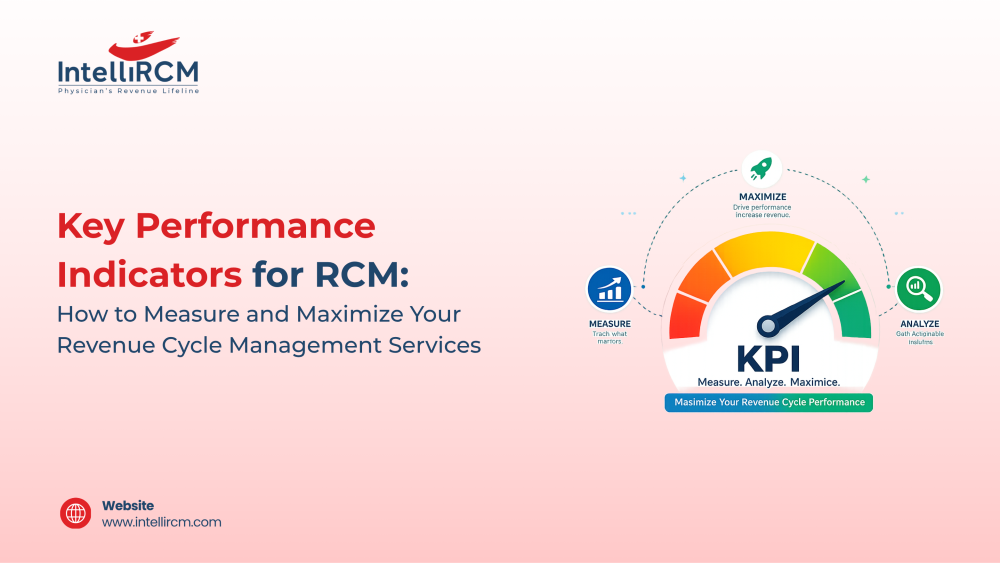
In healthcare, financial stability does not happen by accident. It is built claim by claim, payment by payment, and decision by decision. Yet many practices across the United States leave significant revenue on the table—not from lack of skilled staff or quality patients, but because they are not measuring what truly matters.
That is where Key Performance Indicators, or KPIs, come in.
KPIs are the vital signs of your revenue cycle. Just as a physician monitors a patient's blood pressure, heart rate, and oxygen levels to assess health, healthcare administrators must monitor specific financial metrics to assess the performance of their billing operations. Without this data, inefficiencies go unnoticed, denials pile up, and collections fall short.
Whether you run a small independent practice or a large group, understanding and acting on your RCM KPIs is the difference between thriving and constantly struggling to stay financially afloat. Partnering with expert revenue cycle management services gives you the tools and expertise to consistently improve these numbers.
This blog breaks down the most critical KPIs every RCM team must monitor and explains how optimizing each one leads to stronger financial outcomes for your organization.
KPIs in revenue cycle management are measurable values that reflect how well a healthcare organization manages billing, collections, and financial processes. They turn complex operations into simple numbers, showing where your revenue cycle works well and where it breaks down.
Think of KPIs as your financial compass. Without them, your team is navigating in the dark. With them, every decision, from staffing to technology investment to process redesign, is grounded in real data.
Today, as reimbursement rates tighten and payer rules grow complex, benchmarking your RCM performance is essential. Even top RCM billing services rely on KPIs to identify gaps and drive improvement.
The clean claim rate measures the percentage of claims submitted to payers that are accepted and processed on the first attempt without any errors, rejections, or additional information required.
The industry benchmark for a high-performing practice is 95% or above. Anything below this threshold signals systemic issues in your coding, documentation, or eligibility verification processes.
A low clean claim rate creates costly issues. Rejected claims require correction and resubmission, delaying payment, increasing administrative work, and risking missed deadlines. Professional RCM services address this by using claim scrubbing, real-time eligibility checks, and coder audits.
Days in Accounts Receivable measures the average number of days it takes your practice to collect payment after a service has been rendered. The lower this number, the faster your revenue is moving through the cycle.
The benchmark is under 40 days. Practices with AR days of 50–60 days or more lose revenue, often due to slow claim submissions, weak follow-up, or high volumes of unresolved aging balances.
Reducing AR days needs a proactive approach to claim submission, regular follow-up, and real-time reporting. Skilled RCM services automate submission, prioritize aging claims, and use dedicated teams for follow-up.
The denial rate is the percentage of claims that payers reject and do not reimburse. While some level of denial activity is expected in any billing operation, top-performing practices keep their denial rate under 5%.
The national average hovers around 10-15%, indicating that many healthcare organizations are losing a significant portion of their potential revenue to preventable denials.
Common denial triggers include incorrect coding, missing authorizations, eligibility mismatches, and late submissions. Many denied claims are recoverable if your team acts quickly. The best RCM services have dedicated denial management and root cause tools to prevent and fix denials.
The net collection rate is one of the most telling KPIs in the entire revenue cycle. It measures the percentage of collectible revenue your practice actually collects after accounting for contractual adjustments.
Top practices keep net collection rates at 95–99%. Anything below 95% means collectible revenue is lost due to write-offs, missed follow-ups, or weak billing processes.
This metric proves effective revenue cycle management. It is not about the claims you submit, but how much you actually collect.
The First Pass Resolution Rate measures the percentage of claims submitted, processed, and paid by the payer on the first attempt, with no rework required.
A strong FPRR, generally 90% or above, is one of the clearest signs that your billing operation is running efficiently. Every claim that requires a second or third submission represents wasted time, increased administrative cost, and delayed cash flow.
Improving FPRR requires precision at every step of the billing workflow, from accurate patient registration and eligibility checks to clean coding and timely submission. Experienced RCM billing services invest in workflow automation and quality controls that consistently improve FPRR, reducing the burden on your internal team while accelerating reimbursement.
Cost to collect measures the total operational expense required to collect one dollar of net revenue. It is expressed as a percentage and reflects the overall efficiency of your revenue cycle operation.
Industry benchmarks typically range from 3% to 7%, with larger, more efficient practices on the lower end. A high cost to collect signals that your billing processes are labor-intensive, technology is underutilized, or claim volumes are being mismanaged.
Lowering your collection costs is not about cutting corners. It is about working smarter, automating repetitive tasks, reducing rework, and partnering with RCM experts who bring scale and efficiency that most in-house teams cannot replicate.
As high-deductible health plans continue to grow in popularity, patients are now responsible for a larger share of their healthcare costs than ever before. The patient collection rate measures how effectively your practice collects balances directly from patients.
The benchmark varies by specialty and payer mix, but leading practices aim for a patient collection rate of 80% or above. Falling short of this benchmark suggests issues with your front-end eligibility education, billing statement clarity, or payment option flexibility.
Improving patient collections requires a patient-friendly billing experience: clear statements, flexible payment plans, digital payment options, and timely outreach. Revenue cycle management services that incorporate patient engagement tools and financial counseling workflows see measurable improvement in this often-overlooked KPI.
Measuring your KPIs is the starting point, not the finish line. Data that sits in a report without triggering action is just noise.
Many practices make the mistake of pulling monthly reports, reviewing the numbers briefly, and moving on without implementing meaningful change. The real value of KPI tracking comes from building structured review cycles, assigning accountability to specific metrics, and creating action plans when performance dips below benchmark.
Experienced RCM services do more than provide dashboards. They interpret data, find root causes, and deploy solutions to improve. Top-tier partners audit claims, review denials, and regularly benchmark performance.
Not all RCM vendors are created equal. The difference between an average billing company and a high-performing RCM partner shows up directly in your KPI results.
The best RCM management services deliver end-to-end coverage across every stage of the revenue cycle: insurance eligibility verification, accurate medical coding, clean claim submission, proactive denial management, payment posting, and patient billing. Each of these functions directly influences one or more of the KPIs outlined above.
For practices across the United States, working with a specialized RCM partner means gaining access to technology-driven workflows, payer-specific expertise, and dedicated teams focused entirely on maximizing your reimbursements. You are not just outsourcing a task. You are gaining a strategic financial partner whose success is directly tied to yours.
The measurable outcomes speak for themselves: faster payment cycles, lower denial rates, higher net collection rates, and reduced administrative overhead. When you align with the right revenue cycle management services, your KPIs do not just improve on paper. They translate into real dollars and stay within your organization.
IntelliRCM gives your practice full visibility into clean claim rates, AR days, denial trends, and net collection performance - then works alongside your team to improve every number. Your revenue cycle metrics can be better than the national benchmark.
Before setting targets, you need an honest look at where you currently stand. Pull your baseline data across all seven KPIs covered in this blog. Identify which metrics are furthest from the benchmark and which are having the greatest financial impact.
From there, prioritize. Trying to fix everything at once leads to scattered effort and minimal progress. Instead, focus on two to three KPIs that represent your biggest revenue gaps, build a 90-day improvement plan around those, and expand from there.
Involve your billing team and your RCM partner in the goal-setting process. Realistic targets are grounded in your current workflows, payer mix, and practice size. What is achievable for a 20-physician orthopedic group may look different from what is realistic for a solo primary care provider.
Finally, commit to quarterly reviews. KPI goals are not static. As your practice grows and your workflows improve, your benchmarks should rise accordingly.
At IntelliRCM, we bring more than two decades of expertise to every aspect of the revenue cycle. We understand that behind every KPI is a real practice trying to serve patients without sacrificing financial sustainability.
Our comprehensive revenue cycle management services are built around one goal: maximizing your collections while minimizing your administrative burden. From clean claim submission and real-time eligibility verification to aggressive denial management and transparent KPI reporting, every service we offer is designed to move your metrics in the right direction.
As one of the most trusted RCM billing services in the industry, IntelliRCM combines advanced technology with hands-on expertise to deliver results that speak for themselves. Our clients consistently see reduced AR days, improved first pass resolution rates, and net collection rates that outperform national benchmarks.
If you are looking for the best RCM management services in the USA, IntelliRCM is the partner built for practices that refuse to settle for average. We do not just manage your revenue cycle. We optimize, protect, and grow it alongside your practice.
Learn how end to end revenue cycle management improves healthcare cash flow, reduces claim denials, and streamlines billing. Read the blog to strengthen your RCM
Read Full GuideStrong KPI performance is not a luxury reserved for large health systems with massive medical billing departments. It is an achievable standard for every practice that is willing to measure the right metrics, act on the data, and partner with experts who know how to drive results.
From your clean claim rate to your patient collection rate, every KPI covered in this blog represents an opportunity to recover revenue that is rightfully yours. The practices that thrive financially are the ones that treat their revenue cycle with the same discipline and attention they bring to patient care.
IntelliRCM is here to help you get there. Our revenue cycle management services are designed to give your practice the clarity, performance, and financial confidence it deserves.
Contact IntelliRCM today and take the first step toward a revenue cycle that truly works for you.

Track DSO, CEI, ADD, AR Turnover, and Aging to boost collections. Improve your revenue cycle management services with IntelliRCM. Get expert help today.
Read More
Learn how end to end revenue cycle management improves healthcare cash flow, reduces claim denials, and streamlines billing. Read the blog to strengthen your RCM
Read More
Reduce dental claim denials and speed up payments with proven insurance verification and RCM strategies. Connect with IntelliRCM to grow your practice revenue.
Read More